On the Astral Heavens, the Nature of Ley and Mana, and the Consequences of the CovenantOn the Physical Heavens and the Reckoning of Time
 Widder Press
On the Astral Heavens, the Nature of Ley and Mana, and the Consequences of the Covenant
Blog : A Pocketful of Infinity
21/11/2026
Being the Second Part of a Treatise on Celestial Mechanics and their Application to Magical Practice
Composed by a Magus of the Pesh Cabal, for the instruction of candidates of the Third Circle and above
In Part One we established the physical architecture of the heavens — the planets, the moons, the calendars, and the conjunctions. If you have not read that section, stop now and do so. What follows builds directly upon it, and candidates who attempt Part Two without the foundation of Part One invariably embarrass themselves in ways that are tedious for everyone involved.
I must also be clear about something before we proceed, because clarity on this point will save you from a category of error that has cost more than one promising practitioner their credibility, and in extreme cases rather more than that.
Everything in Part One is, broadly speaking, established fact. The planets exist. The moons move as described. The calendars record what they record. You can verify these things with your own eyes on a clear night.
Everything in Part Two is theory.
Not idle speculation — the Cabal does not trade in idle speculation — but theory in the proper sense: frameworks constructed from evidence, inference, and careful reasoning, which remain open to revision as understanding deepens. I will tell you what the Cabal currently believes, why we believe it, where we are uncertain, and where we disagree with our colleagues in Trunia. I will not pretend that disagreement does not exist, nor will I pretend that the Royal Society of Adepts is entirely wrong simply because they are occasionally insufferable about being right on the smaller questions.
The larger questions remain open. That is what makes them interesting.
Part One: The Architecture of the Planes
Begin with what we know. Or rather — begin with what we believe we know, which is a different thing, and the difference matters.
The world we inhabit — the temporal world of Thayathorn, of stone and weather and the turning of seasons — is not the totality of what exists. Every serious magical tradition on this continent, from the Pesh Cabal to the Royal Society to the oldest Amonite practitioners, agrees on this much. Beyond the material world lies something else. The nature of that something else is where agreement ends.
The Cabal's current model — and I stress that it is a model, not a map — proposes the following structure. Picture it as a series of concentric layers, though I warn you immediately that this spatial metaphor is imprecise. The planes do not sit neatly inside each other like the layers of an onion. They overlap. They bleed into each other at their boundaries. The metaphor is useful for instruction and should be abandoned the moment it becomes a constraint on thinking.
The Temporal World is where we stand. Physical laws govern it. The sun rises. Objects fall. People die. It is the plane of consequence, of irreversibility, of time moving in one direction. It is also, the Cabal believes, the least fundamental of the planes — the most derived, the most structured, the furthest from the raw stuff of existence. This is not a demotion. A finished building is no less real than the stone it was quarried from.
The Ethereal — what the older traditions call the Shadowlands — is the boundary zone between the temporal world and the astral. It is not quite material and not quite astral. Both sets of physical laws apply there simultaneously, which produces an environment that is deeply strange to anyone accustomed to the temporal world. Distances behave differently. Causation is less reliable. Things that cannot coexist in the material world can coexist in the Ethereal, though not comfortably and not indefinitely.
Most practitioners who work beyond the temporal world work in the Ethereal and go no further. This is sensible. The Ethereal is strange but navigable. What lies beyond it is not.
The Astral Plane — Lodrial in the older terminology, the Ethrial in the framework presented by this Cabal's own published guides — is, as best we can determine, infinite. It is governed not by physical law but by will and imagination. Things exist there because something believes they exist, or because something powerful enough has made them exist, which amounts to the same thing. It is the plane of pure potential. It is also the plane through which the great spiritual entities — the angels, the demons, whatever the Old Ones truly are — move and operate when they engage with our world at all.
Beyond the astral — and again, beyond is the wrong word, deeper into is better, though still imprecise — lie the Deeps. Edras, which some call the Lower Heavens. The Vyre, which most call the Hells. And whatever lies past those, which the Cabal declines to speculate about in formal literature because we have no reliable information and a great deal of unreliable information, and the two are difficult to separate.
Candidates are strongly advised not to go there. This is not a suggestion offered for dramatic effect. It is the considered position of every serious magical institution on Thayathorn, arrived at independently and by different routes. The Deeps are not simply dangerous in the way that a sharp blade or a bad storm is dangerous. They are dangerous in ways that do not translate cleanly into the temporal world's framework for understanding danger. Leave them alone.
Part Two: Ley — Its Nature and Origin
We come now to the central question of practical magical theory, and the one on which the Cabal's position diverges most significantly from received wisdom.
In common understanding — and in the introductory materials that most of you will have encountered before reaching the Third Circle — ley and mana are described as opposites. Ley is natural, the building block of life, the flow of power through the world's hidden veins. Mana is artificial, constructed, destructive. One belongs here. The other does not.
This is not wrong, precisely. As a description of how ley and mana behave in the temporal world, it is broadly accurate and practically useful. But the Cabal's current theoretical position is that it is a local truth being mistaken for a universal one — a description of consequences being mistaken for a description of causes.
Here is what we actually believe.
Ley does not originate in the temporal world. It originates in the Ethereal — specifically, in the boundary processes that occur where the temporal world and the astral plane press against each other. The Ethereal is not simply a space between two planes. It is an active zone of interaction, and ley is what that interaction produces. It is, in the Cabal's theoretical framework, the energy generated by the friction and overlap of two fundamentally different sets of physical law.
This ley bleeds inward — toward the temporal world — and is absorbed into the material plane through the ley line network. The ley lines are not simply channels. They are the points where the material world is most receptive to this inward bleed, where the boundary between temporal and Ethereal is thinnest. Along these lines, ley saturates the stone, the soil, the water. It becomes, over geological time, inseparable from the structure of the living world.
This is why the Cabal holds — cautiously, and not in our published literature — that ley is not merely used by life. Ley is life, in the most fundamental sense available to us. Not a metaphor. Not a poetic approximation. The processes that constitute living things — growth, repair, reproduction, the basic continuity of a living organism from one moment to the next — are, we believe, expressions of ley saturation in matter. Remove ley from a living system entirely, and you do not have a dead organism. You have something that was never alive in the first place.
I am aware that this position is considered extreme by some of our colleagues. The Royal Society has produced extensive empirical work on ley behaviour at the microscopic level — the interaction of ley with individual cells, with specific materials, with the precise mechanisms of healing magic — and their data is excellent. Their interpretation of that data, however, does not extend to this conclusion. They see ley as a resource that living things use. We see it as a substrate that living things are made of. Both positions are consistent with the available evidence. This is, frankly, one of the more interesting open questions in contemporary magical theory.
Part Three: Mana — The Mirror Boundary
If ley is generated at the boundary between the temporal world and the astral, the question that follows — and which the Cabal has been working toward for the better part of two centuries — is whether a corresponding process occurs at the other boundary of the astral. The boundary between the infinite astral and the Deeps.
Our current answer is yes.
Mana originates in the deeper shadowland — the boundary zone between the astral plane and the Deeps, which is the structural equivalent of the Ethereal on the other side. Just as the Ethereal is generated by the interaction of temporal and astral laws, this deeper boundary is generated by the interaction of astral and Deep laws. And just as that interaction produces ley on the temporal side, it produces mana on the Deep side.
Mana, in this framework, is not inherently destructive. It is the natural energetic product of a boundary process, structurally equivalent to ley. In the Deeps themselves — in the environments shaped by the great entities that inhabit them — mana presumably functions as ley does here: as a substrate, a building block, the stuff from which Deep existence is constructed.
What makes mana dangerous in the temporal world is precisely that it is not ley. The temporal world is a ley-structured environment. Everything in it — the laws of physics, the biology of living things, the behaviour of matter at every scale — has developed in the presence of ley and is in some sense calibrated to it. Introducing mana into that environment is not like introducing a poison, which operates within the system's existing framework to damage it. It is like introducing a different framework entirely. Mana does not damage ley-structured matter in the way a blade damages flesh. It unmakes the ley structure, and the matter, deprived of its fundamental substrate, behaves in ways that have no good analogy in normal experience.
This is why mana in the temporal world appears destructive. It is not destroying things. It is dissolving the framework that makes things possible.
The practical implication — and this is not theoretical, this is established practice — is that exposure to high mana concentrations in deep astral travel is dangerous independent of any entities one might encounter. The deeper one goes into the astral toward the Deep boundary, the higher the ambient mana concentration. There is no safe threshold that the Cabal has been able to establish. There is only increasing risk with increasing depth. The entities in the Deeps are the reason experienced practitioners do not go there. The mana environment is the reason foolish ones do not come back.
Part Four: The Astral as Contested Ground
The astral plane sits between these two boundary processes — ley pressing inward from the Ethereal side, mana pressing inward from the Deep side. It is, in a very real sense, the space where these two fundamental forces exist in tension.
This tension is not uniform. In the regions of the astral closest to the Ethereal — the parts most accessible to practitioners working from the temporal world — ley concentration is relatively high and mana concentration is relatively low. As one moves deeper into the astral, this balance shifts. The middle regions of the astral are, theoretically, where the two forces reach approximate equilibrium. The regions approaching the Deep boundary are increasingly mana-dominant.
The Royal Society's position is that this gradient is stable and predictable — that the astral has always been structured this way and that the behaviour of both forces can be mapped with sufficient precision to make deep astral travel, if not safe, at least calculable. They have produced detailed charts of ley-mana gradients in the accessible regions of the astral, and their charts are, by all accounts, accurate within those regions.
The Cabal's position is that the Royal Society is measuring a system that has been profoundly disrupted and does not know it. Which brings us to the Covenant.
Part Five: The Bastion and What It Has Done
The Covenant — the great working performed by the Thanes in the burning city of Stoy, intended as a ward against the Old Ones and transformed by catastrophe into something far larger — produced the Bastion. The physical boundary that seals Thayathorn. Nothing living crosses it. This much is not theory. This is established historical and observational fact.
What is theory is everything that follows from it.
The Cabal's first position concerns the ley network and what we call the amplification effect. Under normal cosmological conditions — the conditions that existed before the Covenant, and that presumably still exist beyond the Bastion — ley generated at the Ethereal boundary bleeds into the temporal world and also bleeds outward into the broader astral, where it dissipates. The Bastion prevents this outward dissipation. Ley that would normally bleed away into the infinite astral beyond Thayathorn is instead reflected back. It builds. The interior of the Bastion, over the two thousand years since the Covenant, has accumulated a ley concentration in the Ethereal and temporal layers that is, we estimate, substantially higher than anything the pre-Covenant records describe.
This is why the astral tides on Thayathorn are so extraordinarily powerful. It is why the planetary and lunar events described in Part One produce effects that appear, by comparison with records from the Great Empire, to be categorically more intense than anything experienced before the Covenant. Those records describe manageable tides. What we experience is a closed system under pressure, where every tidal surge reverberates rather than dissipates, amplifying with each reflection against the Bastion's inner surface.
The ley lines are the material world's mechanism for absorbing and distributing this amplified energy. Without them, the concentrated ley in the Ethereal layer would be catastrophic — the temporal world would be saturated beyond anything living matter could tolerate. The ley network is, in this reading, not simply a natural feature of the world. It may be, at least in its current form and density, a consequence of the Covenant — the world's own response to conditions it was not designed to handle.
This is the Cabal's position. The Royal Society disputes the amplification mechanism. They acknowledge that tidal intensities are higher than pre-Covenant records suggest, but attribute this to the unreliability of those records rather than to a fundamental change in cosmological conditions. They are, in our view, declining to follow the evidence where it leads because the conclusion is uncomfortable. Amplification implies instability. Instability implies that the system may not be self-regulating indefinitely. That is not a conclusion the Royal Society, embedded as it is in the governmental structures of Trunia, finds it convenient to reach.
Part Six: Two Theories of the Bastion's Depth
The second and more contested question concerns whether the Bastion penetrates beyond the temporal and Ethereal layers into the astral itself — and if so, how far.
The evidence does not currently allow us to prefer one answer over the other. I present both positions honestly, because a candidate who has only heard one of them has not been properly prepared.
The Closed Bastion theory holds that the Covenant's working penetrated all layers simultaneously: temporal, Ethereal, astral, and the boundary with the Deeps. The Bastion is complete. Thayathorn is sealed at every level. The consequence of this is significant: the mana boundary — the deep shadowland on the far side of the astral — is also enclosed within the Bastion. Mana that would normally bleed into the wider astral is reflected inward, just as ley is reflected on the temporal side.
If the Closed Bastion theory is correct, the interior of the Bastion is accumulating elevated mana concentrations in the deep astral, building slowly over two thousand years, pressing inward toward the regions accessible to practitioners. The mana gradient that the Royal Society has charted and declared stable is not stable. It is shifting, slowly, toward the temporal world side. The charts produced fifty years ago are already slightly wrong. The charts produced in another fifty years will be more wrong still. Deep astral travel within Thayathorn is becoming more dangerous over time — not as a function of what one might encounter, but as a function of the environment itself.
The Partial Bastion theory holds that the Covenant's working was extraordinary but not unlimited. It sealed the temporal world and the Ethereal completely. It disrupted the astral significantly. But it did not reach the deep boundary. The Bastion thins and becomes incomplete as one moves deeper into the astral, and at some depth — which the Cabal has not been able to determine — it ceases to exist entirely.
Under this theory, the mana boundary is not enclosed. The deep astral within Thayathorn connects, at sufficient depth, to the unrestricted astral beyond the Bastion. The gods and entities on the outside cannot cross the Bastion in the material or Ethereal layers. But at great depth in the astral, the barrier is absent, and something — not physical passage, not communication in any normal sense, but some form of influence or presence — may be possible.
This would explain certain phenomena in deep astral records that neither theory accounts for comfortably: the occasional reports, from the few practitioners who have gone deep and returned, of encountering presences that feel neither demonic nor angelic in the conventional sense — something older, something that does not fit the established taxonomy of the spirit planes. Under the Partial Bastion theory, these encounters may be precisely what they appear to be: contact, indirect and strange and deeply dangerous, with entities on the other side of the Bastion, bleeding through at a depth where the seal does not hold.
The Cabal has not reached consensus on which theory is correct. The Royal Society has not, to our knowledge, formulated either theory in anything like this form — their empirical focus has not led them to the cosmological question of Bastion penetration depth. This may be one of the areas in which the Cabal's theoretical orientation gives us an advantage, though I will not pretend that theoretical advantage has yet translated into practical knowledge. We do not know which theory is correct. We believe the question is among the most important currently open in magical understanding.
Part Seven: The Celestial Connection — Tying It Together
We return now to the heavens.
In Part One we established that the planets drive the deep tides and the moons modulate them. The question that Part Two must answer — or at least address honestly — is: what are the tides, and why do they do what they do?
The Cabal's current answer is this.
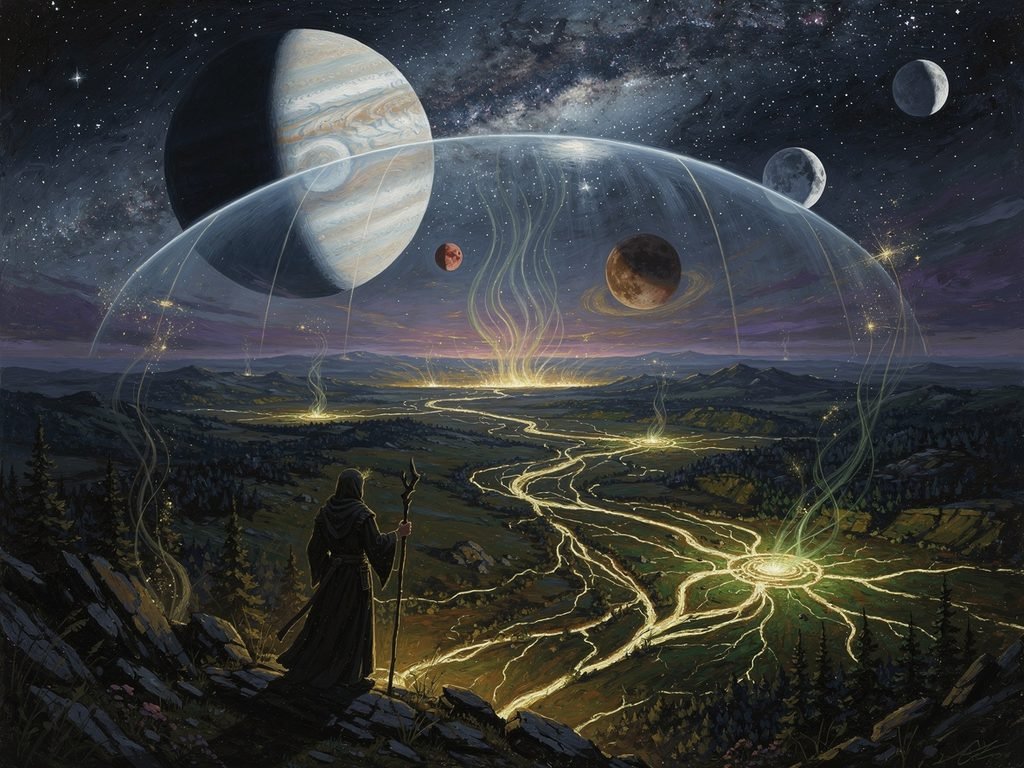
The planets are massive bodies embedded in the temporal world, but their influence does not stop at the material layer. Their gravitational and — we believe — astral mass creates perturbations that propagate through the Ethereal and into the astral plane itself. The astral tides are not merely a material phenomenon with magical side effects. They are a simultaneous disturbance across multiple planes. When Masul reaches its closest approach, the perturbation is felt in the temporal world as a shift in the ley network, in the Ethereal as a visible surge in the boundary layer, and in the accessible astral as a wave of increased ley pressure moving inward from the Ethereal side.
The moons, being smaller and closer, create faster and more localised perturbations. Kana's irregular orbit is significant precisely because her perturbations are not predictable enough to be averaged out by the system. She creates genuine interference patterns in the tidal flow — moments where the ley pressure in the Ethereal spikes or drops suddenly rather than rising and falling on the slow planetary cycle. The conjunctions are what they are because they are moments when multiple interference patterns align — when Kana's perturbation combines with Iaka's, or when Denat's mass adds its own disturbance to an already disrupted system.
Under normal cosmological conditions, these tides would be significant but manageable. They would propagate through the Ethereal, influence the material world measurably, and then dissipate outward into the broader astral.
Under the Bastion, they do not dissipate. They reflect. The Ethereal layer within the Bastion is, two thousand years after the Covenant, a system under continuous amplifying pressure. Every planetary cycle reinforces the previous one. Every conjunction adds to what the previous conjunction left behind. The ley network in the material world is absorbing and distributing energy that its pre-Covenant equivalent never had to handle.
What this means practically is something that every serious practitioner already knows from experience, even if they have not framed it in these terms: the tides on Thayathorn are not like the tides described in the old records. They are not like the manageable forces that the first-wave colonists, drawing on knowledge from the Great Empire, expected to find here. They are something else — amplified, pressurised, prone to resonance effects during major conjunction events that can stress the ley network for weeks afterward.
The Chain is the clearest example. The Cabal's records contain seventeen documented Chain events since the founding of the order. In three of those events, ley lines in the affected regions showed measurable disruption for periods ranging from three weeks to four months following the conjunction. This does not happen once and cease. Each Chain event deposits something in the system that does not fully dissipate before the next one. We do not know whether this is cumulative without limit or whether the system reaches an equilibrium. The Royal Society believes it reaches equilibrium. The Cabal is less certain.
The question of whether the mana side of the system is undergoing an equivalent process — whether the Closed Bastion theory is correct, and whether mana concentrations in the deep astral are slowly rising — is one that we cannot currently answer with the evidence available. What we can say is that the responsible position is to treat it as an open question rather than a settled one.
Concluding Observations
I want to close with something that is less theory and more orientation — a way of thinking about what we have covered that may serve you better than any specific piece of knowledge.
Magic is not a science. The Cabal and the Royal Society are both attempting to make it one, and that attempt is valuable and necessary. But we are working with phenomena that operate across multiple planes simultaneously, that have been profoundly disrupted by a catastrophic event two thousand years ago, and that involve forces — ley, mana, the nature of the Deeps — which we understand only partially and at the edges. The frameworks we have built are the best available. They are not complete.
What the celestial picture gives us — the planets, the moons, the conjunctions, the calendars — is a set of reliable observational anchors in a field where reliability is difficult to come by. The sky is measurable. The conjunctions are predictable. The tides they produce, while amplified beyond anything the pre-Covenant records describe, are at least consistent in their timing if not always in their intensity. For a practitioner working in the Ethereal, or attempting deep astral work, or timing a significant ritual, the celestial picture is the most solid ground available.
Stand on it. Understand it thoroughly. And when you step off it into the deeper theoretical territory we have explored in this part of the treatise, do so with the awareness that you are leaving solid ground.
The best practitioners in this Cabal's history have been people who knew exactly how far from certainty they were at any given moment. That knowledge did not make them timid. It made them precise.
That is what we are asking of you.