The Kingdom that was quietly forgotten
 Widder Press
The Kingdom that was quietly forgotten
Blog : The Shape of Echoes Past
14/11/2026
There are histories that end with a battle, a treaty, or the death of a ruler. Dauria’s history is less obliging. Its Kingdom disappeared from the maps, its authority was reduced to a memory in the merchant cities, and the Confederation that followed preferred to speak of liberty rather than inheritance. Yet a royal house remained, and the old name did not vanish as neatly as later histories would have us believe.
I. The Provinces of Garrin
The Garrinese first laid claim to the Daurin Isles in the second century of the Trunian Reckoning, incorporating them into the Imperium as the Province of Dauria, or, in the plural, the Daurin Provinces. The language was administrative, as imperial language tends to be: it made a collection of islands sound like a single possession and the people who lived there sound like subjects whose consent was immaterial.
For generations, Garrinese authority rested on ports, garrisons, appointed officials, and alliances with those local powers willing to prosper beneath the imperial umbrella. Marakan became a particularly important centre of that authority. Its Saanite Order possessed a fortress, archives, wealth, and an institutional memory that outlasted individual governors. The Order’s religious standing gave it legitimacy; its island stronghold made that legitimacy difficult for distant rulers to enforce or revoke.
The Dakenthors were woven into this history before they became the last imperial dynasty. Their family had risen to prominence in the Daurin Isles, and its members held influence within the provinces even as the family’s ambitions turned towards the mainland. In 752 TR, Daven V took the Garrinese throne. Later generations remembered him as Daven the Cruel. His reign was marked by war and the costly effort of maintaining an empire whose borders were increasingly difficult to defend.
Daven V was killed in the Fifth Tash Campaign in 785 TR. His death did not bring stability. Arcan II succeeded him, only to be assassinated in 792; Philese I, remembered more kindly as Philese the Good, followed and was herself assassinated in 800. The succession tells us something that grand imperial histories often omit: the dynasty claiming the right to rule the known world could not reliably keep its own rulers alive.
The Daurin Wars unfolded against this longer weakening of Garrinese power. They lasted for more than a century, and it is misleading to imagine independence as one clean uprising on one decisive day. Different islands and cities reached their own settlements at different times. Garrin’s authority ebbed unevenly, while local leaders weighed the risks of resistance against the opportunities presented by an empire increasingly occupied with its own survival.
II. The Star Turns
Marakan’s position made it central to the struggle. The Saanite Order had long been an anchor of imperial administration, yet it was also a power in its own right. Its leaders could see that the old order was failing; they could also see that the next order might be no kinder to institutions that stood outside the control of a crown.
The public story places the decisive change in the hands of Grandmaster Percihal Manta. After a period of private reflection recorded in Saanite chronicles as the Vigil of the Star, Percihal declared Garrinese imperial legitimacy forfeit and committed the Order’s resources to independence. Marakan, once an anchor of imperial administration, became a centre of rebellion with startling speed.
That account is true as far as it goes. It may not go very far. The Saanites did not merely wake one morning and discover that the future had changed. The Conclave of Umash, an Order of Kii-Anna, had long maintained a discreet relationship with the royal household. Its sisters served the Darkstar, goddess of death, thresholds, and passage between states of being. Their rites concerned not only the dead but the counsel that might be preserved through them. The Conclave’s work was rarely entered into public records, and its influence is difficult to measure precisely because those who knew of it had reason not to write it down.
The evidence suggests that the Saanites anticipated both the disintegration of Dakenthor rule and the revolution that would follow on the mainland years before either became unavoidable. The divinations of Conclaves sisters were interpreted as a sequence of political events, not simply as a warning of general upheaval. A plan was put in motion: the Order would withdraw its legitimacy from Garrin at the moment that could most decisively change the balance of power; the Mantas would carry the transition into civil rule; and the Order’s assets would be secured before a new mainland monarchy could demand their surrender.
How much Percihal himself knew, and how much was confined to the Conclave and a small circle of initiates, remains uncertain. It is tempting to imagine a prophecy that named every battle and every ruler. Temptation is not evidence. What can be said is that Marakan’s change of allegiance was too consequential—and its preparations too useful to those who survived the transition—to be dismissed as a sudden conversion of conscience.
III. The Accord of Dabon
The Kingdom was founded at Marakan in 765 TR, before the agreed date of independence. This is not a contradiction if one distinguishes a royal project from a recognised government of all the Daurin Isles. In 778 TR—Year 1 of the State Calendar, corresponding to 1859 Z—the Kingdom was recognised as the government of the Isles. The date became the Confederation’s chosen point of historical reference, although it should not be taken to mean that every city became independent simultaneously.
The Accord of Dabon formalised the new arrangement. The Saanite Order separated itself from civil governance, and House Manta became a royal dynasty rather than a knightly leadership. Those Mantas who remained within the Order’s administrative structure became associated with House Rantee, which continued to manage internal affairs and maintain a close relationship with the royal household.
The Accord was presented as a settlement of authority. It was also a settlement of property, influence, and survival. The Saanite wealth was secured before the Order’s eventual dissolution, and the Mantas gained a crown whose legitimacy rested on the independence they had helped bring about. The later Trunian revolution would seek to bring independent knightly orders under royal control, merging them into the Triumvirate and requiring the Saanites to join the Melcene Knights. By then, the most valuable transfer had already taken place.
It would be unfair to reduce the entire episode to a conspiracy; it would be naïve to pretend that no conspiracy was involved. The Saanites had institutions to preserve, the Mantas had a political future to secure, and the Conclave had foreseen a narrow passage through which both might survive. Religious conviction and political calculation need not be enemies. In Marakan, they appear to have been unusually effective partners.
IV. The Silver Dragon
The Dakenthors did not disappear from Daurian affairs when their authority weakened. The family’s history divided into several strands, and later heraldry makes those divisions easier to see than the contemporary records do. The Dakenthors branch now associated with Daren Kair retained the Black Dragon; the Tasindays of Sharathan bore the Red Dragon; and the Manderlays became associated with the Silver Dragon, often shown as three white dragons on a black field.
The Manderlays were not strangers who happened to rise in the same commercial world. They shared blood with the Dakenthors. During the Daurin Wars, members of this branch supported the independence movement while the principal Dakenthor line remained tied to the Imperium. They continued to use the Dakenthor name for a time. Only after the Masul Revolution, when the old name had become a liability in trade, did the branch adopt Manderlay as its public family name. A change of name does not prove a change of blood.
The surviving record is thin, and the merchant archives are not always candid. Later accounts remember Étienne de Manderlay as a discreet opponent of the imperial position, carrying messages and resources between rebellious merchant cities. Lucien de Manderlay is credited with building commercial networks that challenged Marakan’s influence, while Amélie de Manderlay is associated with arguments that political opportunity should not be reserved for those born to rank. The details of these figures’ lives remain uncertain; some accounts may have been embellished by descendants eager to make a principled history out of a profitable one.
Yet the broad pattern is credible. The Manderlays could support independence without abandoning the advantages of family connections. They had reason to oppose the empire’s claims, and later reason to obscure the closeness of their ancestry to its final dynasty. The Silver Dragon’s survival in the City States is one of the quieter reminders that political revolutions rarely sever every thread they claim to cut.
V. A Crown Without Its Cities
The Kingdom’s authority did not collapse in a single succession dispute, nor did it end in 778 TR. That year marks recognition of the Kingdom as the government of the Isles; it is the beginning of the State Calendar, not the date of the Kingdom’s dissolution. Over the following two centuries, the merchant cities increasingly guarded their own interests. Royal authority became nominal in places where the crown had once claimed obedience.
The Kingdom’s decline was therefore a process: first the weakening of direct authority, then the growth of autonomous city governments, and finally the replacement of the wider royal framework by the Confederation. The Confederation emerged only some years after the Kingdom formally ended. Its precise founding date is not established in the sources available to me, and I will not supply one merely to make the chronology look tidy.
Marakan followed a different path. It entered the Confederation as a sovereign member and retained its royal house, while formally waiving its rights as a trading power under the Confederation’s commercial charter. The arrangement puzzled contemporaries and continues to puzzle historians. Other cities competed for trade; Marakan cultivated discretion, secure assets, and the appearance of permanence. The Manta monarchy survived there after the wider Kingdom of Dauria had ceased to exist as a political entity.
That distinction matters. The Kingdom ended; the royal lineage did not. The Confederation could abolish the wider crown without removing every surviving institution that had once belonged to it. Marakan’s continued sovereignty is not proof that the old Kingdom secretly remains intact. It is, however, proof that the end of a state and the end of its inheritance are different events.
VI. The Official Ending
The account in Another World: A Thayathorn Companion Guide gives 779 TR as the year the Kingdom ended and attributes its dissolution to succession disputes. That version is wrong. It confuses the shared reference point for Daurian independence with the much later end of the Kingdom, and it compresses a long political transformation into a tidy dynastic explanation.
The more defensible chronology is this: the Kingdom was founded at Marakan in 765 TR; it was recognised as the government of the Daurin Isles in 778 TR, the first year of the State Calendar; and it formally ended in 983 TR, or 206 SC. The Confederation followed some years later. These dates do not make every dispute disappear, but they distinguish events that the older account mistakenly treats as one.
The error is understandable as political history often is: later institutions inherit the dates that serve their public memory. The Confederation’s founding story places independence at the centre and monarchy at the margins. That story is useful, but usefulness is not the same as accuracy. A historian’s duty is not to protect a comfortable account from inconvenient facts.
VII. What the Mountain Keeps
The old Saanite motto survives: “What the Mountain Guards, the World Forgets.” It was written for a fortress and its sacred charge, but it might equally describe the history of Dauria. Records are lost, names change, and public histories are revised until the past appears to have arrived at the present by the only route that could ever have been taken.
The Kingdom of Dauria is usually spoken of in the past tense. Its crown no longer rules the merchant cities; its authority has been replaced by a Confederation that defines itself against the privileges of monarchy. Yet in Marakan the Manta royal house remains, sovereign within its own city, descended from the political settlement that made the Kingdom possible.
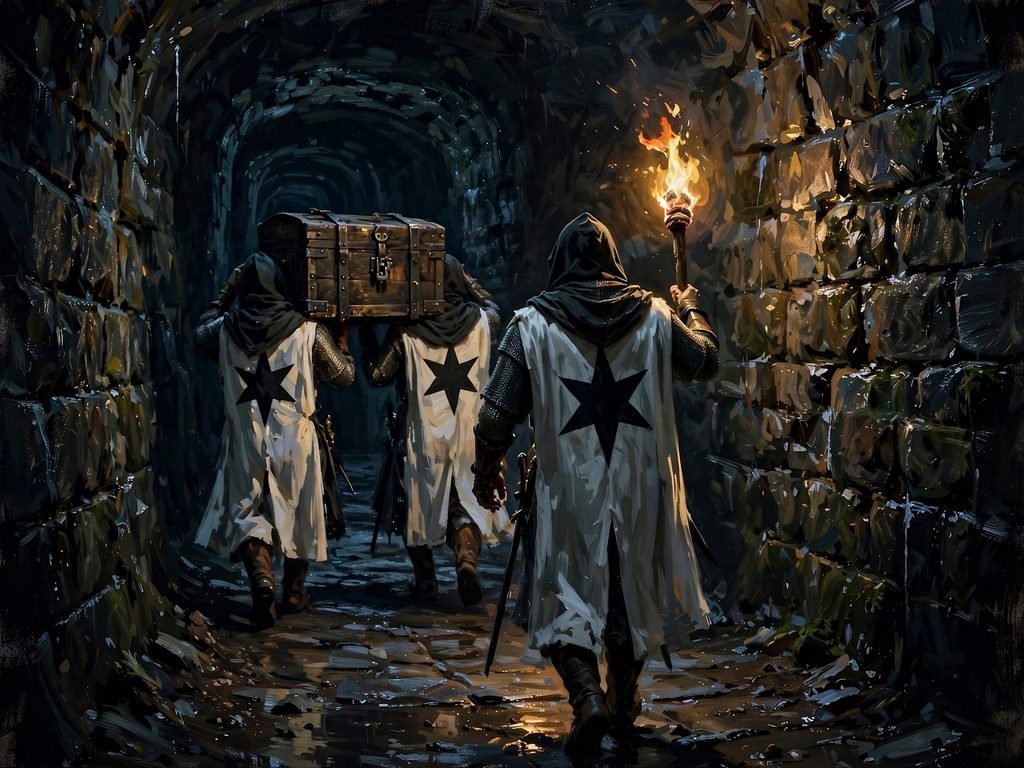
Perhaps this is no more than a remnant: a crown preserved by treaty and custom, its former kingdom reduced to a chapter in the histories of other states. Or perhaps the survival of the house was the point all along. The Conclave of Umash looked towards a future in which Garrinese authority would fail and a new mainland crown would seek to bring independent orders to heel. The Saanites prepared; the Mantas inherited; the wealth was moved; and the records, where they survive, tell only part of the story.
I offer no claim that the Kingdom secretly endures in its former shape. It does not. But if we say that Dauria was lost, we should be precise about what was lost: a political union, a royal authority over the Isles, and the claim that one crown could speak for them all. The lineage survived in Marakan. The memory survived in the City States. And somewhere in the mountain’s guarded records, there may be more of the story than the living have yet chosen to remember.
Publisher’s Note — On the Dissolution of the Kingdom of Dauria
The account of Daurian history published in Another World: A Thayathorn Companion Guide incorrectly identifies 779 TR as the year in which the Kingdom of Dauria ended, and describes its dissolution as the consequence of succession disputes. This account is inconsistent with the historical record presented here.
The Kingdom’s decline, the erosion of its authority over the merchant cities, and the eventual emergence of the Confederation were distinct developments. Nor did the end of the Kingdom bring an end to the Manta royal house, which retained its sovereignty in Marakan and continues to this day.
The present article supersedes the earlier account. The distinction is important: the Kingdom of Dauria ceased to exist as a wider political entity, but its royal lineage survived. The chronology set out here places the Kingdom’s foundation in 765 TR, its recognition in 778 TR (1 SC / 1859 Z), and its formal end in 983 TR (206 SC). The Confederation emerged some years later; its precise founding date remains unpublished.