
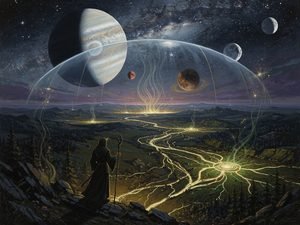
On the Astral Heavens, the Nature of Ley and Mana, and the Consequences of the CovenantOn the Physical Heavens and the Reckoning of TimeNew!!
Begin with what we know. Or rather — begin with what we believe we know, which is a different thing, and the difference matters.
The world we inhabit — the temporal world of Thayathorn, of stone and weather and the turning of seasons — is not the totality of what exists. Every serious magical tradition on this continent, from the Pesh Cabal to the Royal Society to the oldest Amonite practitioners, agrees on this much. Beyond the material world lies something else. The nature of that something else is where agreement ends.
The Cabal's current model — and I stress that it is a model, not a map — proposes the following structure. Picture it as a series of concentric layers, though I warn you immediately that this spatial metaphor is imprecise. The planes do not sit neatly inside each other like the layers of an onion. They overlap. They bleed into each other at their boundaries. The metaphor is useful for instruction and should be abandoned the moment it becomes a constraint on thinking.
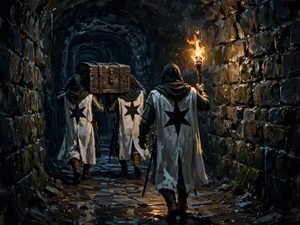
The Kingdom that was quietly forgotten
There are histories that end with a battle, a treaty, or the death of a ruler. Dauria’s history is less obliging. Its Kingdom disappeared from the maps, its authority was reduced to a memory in the merchant cities, and the Confederation that followed preferred to speak of liberty rather than inheritance. Yet a royal house remained, and the old name did not vanish as neatly as later histories would have us believe.
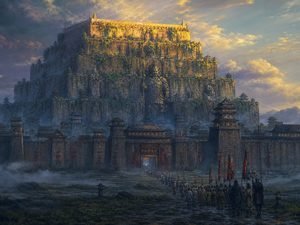
The Madras — A Fortress of Faith and War
There are few buildings in Thayathorn that command the presence of the Madras. Rising above the city of Nakamura, this colossal monastery is both a place of worship and a centre of religious and political influence. Its stepped walls form the shape of a vast rectangular pyramid, rising through nine floors to a broad, flat summit. From a distance, its shallow terraces give the impression of sheer, unbroken walls, while trees and vines wind their way down the stonework, entwined with statues of Arianna, the Prophets, and the Dwali who have led the monastery through the generations.
The Madras is home to more than two thousand Lightwardens, with at least as many priests, pilgrims and attendants living within its walls. It is, in effect, a city within a city: a vast religious community dedicated to the worship of Arianna, Kell’s goddess of war.
But the Madras is more than a monastery. In the unsettled years following the collapse of Imperial authority, it has become one of the most influential religious institutions in the north, and its ambitions have brought it into open conflict with one of Threshia’s most powerful faiths.
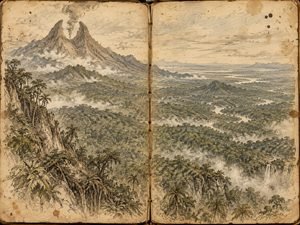
The Quest for the Source of the Elvari
According to the Silash, the River of the People has its source in a great fire mountain known as the Ashen Tusks. The name comes from the two great peaks that curve over the source, like the tusks of some enormous beast. The Silash realms are closed to human visitors, and their accounts of the lands beyond the forests are fragmentary. Nevertheless, the possibility of locating this mountain has long fascinated Threshian explorers.
On the far side of the Dakemoon Morad runs the Ritoran Way, a difficult trade route that bypasses the great Dair Amon desert. From parts of this route, travellers can see a twin-peaked volcano among the distant mountains. It is known as Gul Elvre. Could this be the Ashen Tusks? If the two mountains are one and the same, it might provide an opportunity to solve one of the world's greatest cartographic mysteries: finding the source of the Elvari. More than that, it could reveal a route through the Dakemoon Morad and into the secret interior of the Silash Kingdoms.
On the Physical Heavens and the Reckoning of Time
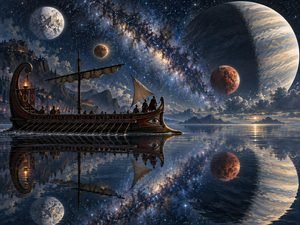
We inhabit the third of five worlds that circle our sun. This is not mythology. This is observation, confirmed across centuries of Cabal records and corroborated by the astronomical traditions of every serious scholarly institution on Thayathorn. Our world is called Edran. The others, in order from the sun outward, are Agriel, Masul, Deshal, and Gleyre.
Of these, Masul and Gleyre are visible to the naked eye on clear nights — Masul burning silver-white and steady, Gleyre a cooler, bluer light that appears and disappears with the seasons. Agriel, being closer to the sun than we are, is rarely seen; it appears only briefly at dawn or dusk, too close to the sun's glare to observe comfortably. Deshal is faint, requiring patience and a clear horizon, best observed in the deep months of its namesake season.
I raise this not merely as astronomical background but because the planets are not incidental to the structure of Edran's magic. They are its architecture. The astral tides — which we will examine exhaustively in Part Two — are planetary in origin. Their deep rhythms, their seasonal surges, the broad magical climate of any given month: all of this flows from the relative positions and gravitational influence of these five worlds. The Pheadran scholars understood this, in their way, and it is no accident that their calendar bears planetary names. They were building something on the right foundation, even if the structure they raised upon it was, as we shall see, somewhat imprecise.
A little bit of history
The very first draft of Scimitar was written way back in 1989. It was… well, let’s be polite and call it “ambitious.” The rules were tangled beyond reason, the grammar suggested I’d never met an English teacher, and the whole thing was scattered across hundreds of bits of paper. But you know what? Buried in that glorious mess were some genuinely good ideas.
The Wreckers Guild – Pirates or just Paranoia?
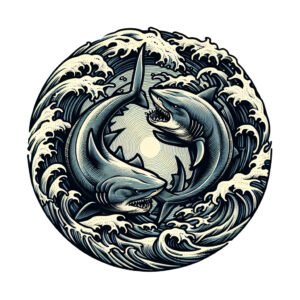
The Wreckers Guild are the pirates of the Grey Sea. But they’re also so much more — and, strangely, sometimes less.
They’re not a fleet in their own right. The Guild isn’t about the ships at all. It’s about the captains. A loose but powerful brotherhood (with the occasional pilot or first mate), who may — or may not — choose to fly the Guild flag. If the flag is up, then everyone aboard — whether willing, unwilling, or blissfully unaware — is part of the Guild in that moment.
Why Are the Sourcebooks Not Published in Order?
Why Are the Sourcebooks Not Published in Order?Blog: Authors Corner 10/10/2025 Otherwise known as The Convoluted State of My Mind “Good question,” I say to myself. And since I know you’re definitely about to ask it, let me get in first and answer it for you. A lot of my sourcebooks were born during the […]