On the Physical Heavens and the Reckoning of Time
 Widder Press
On the Physical Heavens and the Reckoning of Time
Blog : A Pocketful of Infinity
27/06/2026
On the Physical Heavens and the Reckoning of Time
Being the First Part of a Treatise on Celestial Mechanics and their Application to Magical Practice
Composed by a Magus of the Pesh Cabal, for the instruction of candidates of the Third Circle and above
Before we concern ourselves with the astral tides — the subject of the second part of this treatise — we must first establish the framework within which those tides move. I have found, in thirty years of instruction, that candidates who struggle with advanced divination almost always suffer from the same root failure: they do not truly understand the sky above them. They know the names. They can recite the conjunctions by rote. But rote knowledge is not understanding, and it is understanding that the Cabal demands of its members.
Read carefully. Ask questions of yourself as you go. If something seems arbitrary, look again — nothing in the heavens is arbitrary. That is precisely the point.
Part One: The Architecture of the Solar System
We inhabit the third of five worlds that circle our sun. This is not mythology. This is observation, confirmed across centuries of Cabal records and corroborated by the astronomical traditions of every serious scholarly institution on Thayathorn. Our world is called Edran. The others, in order from the sun outward, are Agriel, Masul, Deshal, and Gleyre.
Of these, Masul and Gleyre are visible to the naked eye on clear nights — Masul burning silver-white and steady, Gleyre a cooler, bluer light that appears and disappears with the seasons. Agriel, being closer to the sun than we are, is rarely seen; it appears only briefly at dawn or dusk, too close to the sun's glare to observe comfortably. Deshal is faint, requiring patience and a clear horizon, best observed in the deep months of its namesake season.
I raise this not merely as astronomical background but because the planets are not incidental to the structure of Edran's magic. They are its architecture. The astral tides — which we will examine exhaustively in Part Two — are planetary in origin. Their deep rhythms, their seasonal surges, the broad magical climate of any given month: all of this flows from the relative positions and gravitational influence of these five worlds. The Pheadran scholars understood this, in their way, and it is no accident that their calendar bears planetary names. They were building something on the right foundation, even if the structure they raised upon it was, as we shall see, somewhat imprecise.
Part Two: The Four Moons
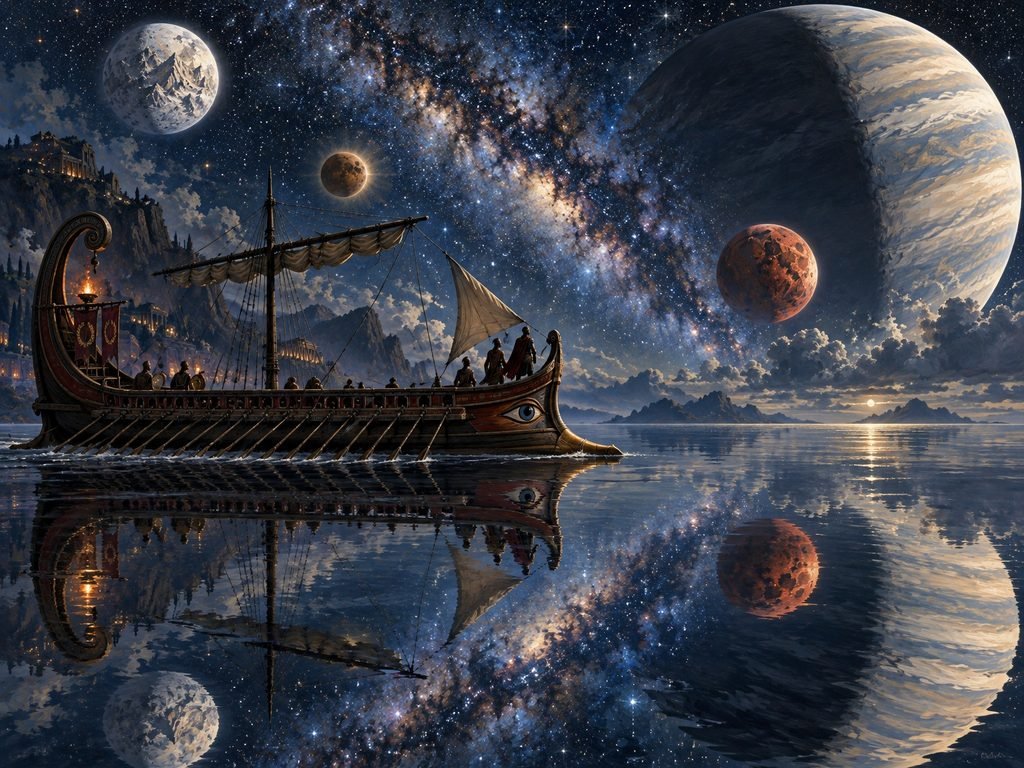
Edran is attended by four moons, each with a distinct character and a distinct role in the celestial mechanics that govern both our tides — physical and magical — and our understanding of time.
Iaka is the closest and most martial of the four: red, cratered, unmistakable. She moves quickly, completing her cycles more frequently than her sisters. If the planetary tides are a slow current beneath deep water, Iaka is a drumbeat on the surface. Her influence is regular and predictable, and by itself relatively modest. But she is rarely considered in isolation.
Kana is the one you must understand above all others. She is small, brown, wrapped in a perpetual veil of atmospheric mist, and she does not behave with Iaka's regularity. Her orbit has a slight irregularity — not large by astronomical standards, but sufficient to make her approach and recession from Edran genuinely variable. It is this variability that makes her the lynchpin of all magical reckoning. When Kana is close, the astral tides surge. When she is distant, they settle. Every serious practitioner in this Cabal has learned to feel the difference, and if you have not yet developed that sensitivity, you will before your Third Circle examination. I promise you that.
Denat is the great moon — by far the largest, dark on one hemisphere and pale-striped on the other. When he swings to his closest approach, he fills enough of the sky to be visible in full daylight. Events involving Denat are rare enough to be significant and large enough to be unmistakable. He moves slowly and announces himself well in advance. There is no excuse for being unprepared when Denat makes his presence felt.
Illaya is the strange one. While the other three orbit Edran along roughly the same plane, Illaya follows a polar path — north to south and back again. She does not drift across the sky the way the others do. She appears overhead, passes, and vanishes, visible only when she is directly above you. She is pale, etched with deep valleys and mountain ridges that catch the light in ways that give her an almost architectural quality when she is close. She is, in the honest assessment of the Cabal, the moon we understand least and the one whose effects are most disruptive when they occur.
Candidates are advised to maintain a personal moon-log for at least one full year before advancing to Third Circle practice. Theory without observation is noise.
Part Three: The Zodiac and the Celestial Calendar
This brings us to the matter of the zodiac — and here I must ask you to set aside whatever half-knowledge you may have acquired from popular culture or, worse, from tavern astrologers. The zodiac of the Amonite tradition is not a decorative system of personality types. It is a functional astronomical framework, and it predates every institution you have ever studied in.
The indigenous peoples of Thayathorn — collectively referred to as the Amonites in the scholarly tradition, though that name collapses considerable cultural diversity into a single word — developed their understanding of the heavens long before the arrival of the colonial waves from the Great Empire. Their zodiac consists of ten signs, each named for a fundamental human activity, each anchored to a dominant star or asterism in its region of the sky, and each carrying mythological and elemental attributes that encode, in narrative form, genuine astronomical and magical principles.
The signs, their stars, and their attributes are as follows:
The Fisherman — anchored by Varath, a deep blue star low on the winter horizon. Patience, hidden depths, the reward of endurance. Associated with water and the deep tides of Gleyre. The Fisherman's mythology speaks of a man who waited forty days on a sea-stone and received everything on the forty-first. Patience is not weakness. It is the deepest kind of knowing. Magical practitioners born under this sign, or working during its ascendancy, often find that sustained workings yield more than rapid ones.
The Sower — anchored by Ellun, a warm yellow star rising at dawn in early spring. Beginnings, faith, legacy. Associated with earth and the renewing tides of Agriel. The foundational myth concerns a woman who planted a seed she would not live to see grow. Her children did. The Sower is the sign of things set in motion that outlast their initiator — relevant to any working intended to persist beyond the practitioner's involvement.
The Hunter — anchored by the three-star cluster of Keth, of which the brightest is the Emeraltus, the great imperial star of Kell. Focus, intent, the decisive moment. Associated with fire and the aggressive tides of Masul. The Kellish adopted the Emeraltus as their own symbol and elevated it above the other two stars of Keth's cluster — a typical act of cultural appropriation, extracting what serves power and discarding the context. The full cluster is more instructive than the single star.
The Weaver — anchored by Shaln, a faint double star visible only to sharp eyes under good conditions. Connection, fate, the hidden pattern. Associated with Deshal, and uniquely among the signs, carries no single elemental alignment — the Weaver connects elements rather than embodying one. In magical practice, the Weaver's ascendancy is propitious for workings that link or bind disparate things.
The Mason — anchored by Durrath, one of the brightest stars in the sky, a steady red point that never sets in northern latitudes. Endurance, foundation, civilisation itself. Associated with earth and Agriel. The Mason's mythology is simple and instructive: he built a wall not to keep anything out, but so his children would know where home was. Every stone placed is a word in a language that outlasts its speaker.
The Shepherd — anchored by Aeln, a pale star that appears to shift slowly relative to its neighbours across the seasons, with the secondary star Sanit nearby. Guardianship, duty, the weight of responsibility. Associated with air and Gleyre. Sanit bears particular cultural significance: it features in the founding mythology of the Saanite Knights and the establishment of Marakan, where it was interpreted as a sign of divine mandate. The Amonite tradition predates and does not share that interpretation, but the star is the same.
The Healer — anchored by Issavar, a blue-white star that pulses almost imperceptibly, noted by careful observers across centuries. Transformation, necessary pain, restoration. Associated with water and Masul. The Healer's knife and the Healer's hand are the same hand. This is not a comfortable sign, but it is an honest one. Workings of healing and transformation are well-supported during its ascendancy, provided the practitioner does not flinch from what the working requires.
The Sailor — anchored by Theran, a bright navigational star near the celestial equator used by virtually every seafaring culture on Thayathorn. Risk, navigation, trust in the unknown. Associated with air and Deshal. Within the Sailor's portion of the sky lies the Albatross — a constellation-level asterism of considerable extent, used as the symbol of the City States Confederation and serving as a navigational marker for coastal peoples across the known world. It is worth noting that the Albatross is not one of the ten zodiac signs but occupies adjacent sky, lending the Sailor's region a distinctly maritime cultural weight.
The Smith — anchored by Vorach, a deep orange star that burns reddish near the horizon, associated in common culture with forge-light. Change through destruction, the necessary breaking, renewal. Associated with fire and Masul. Candidates will note that this sign carries particular resonance in light of the Shaledhe history — the great cultural schism over metalcraft that fractured the Silash peoples and sent the Shaledhe on their devastating migration was, in a sense, a living enactment of the Smith's mythology. The sign was in the sky long before that history. It merely turned out to be accurate.
The Keeper — anchored by Maerath, a cold white star at the celestial pole, around which all other stars appear to rotate. Memory, threshold, the space between worlds. Unlike the other nine signs, the Keeper carries no planetary affiliation. It is Kana-linked — its magical potency is most strongly activated during Kana's perigee. Maerath is known by many names across the cultures of Thayathorn; among the Norkers it is simply the Northern Star, and it figures extensively in their mythology as a fixed point around which fate revolves. They arrived at this independently. That should tell you something about the star's genuine significance.
Part Four: The Two Calendars
We come now to a matter that is, in my experience, the source of more confusion among candidates than any other aspect of celestial study — not because it is difficult, but because most of you have spent your entire lives inside a single calendrical framework and have never been required to think about what it assumes.
There are two calendars in use on Thayathorn. You have grown up with one of them. The other is older, and for the purposes of advanced magical practice, more useful.
The Pheadran Calendar is the calendar of government, commerce, law, and general life. It divides the year into four months of ten weeks each, with nine days to the week, giving a year of three hundred and sixty days. The months — Agriel, Masul, Deshal, and Gleyre — are named for the four observable planets. The days of the week are Larsday, Kayday, Jahnday, Wesserday, Taday, Starday, Boarsday, Neasday, and Thasierday. It was brought to Thayathorn by the waves of human refugees from the Great Empire and formalised in the form we know it by the Pheadran scholars, who were systematic, brilliant, and — on this particular matter — operating with one hand tied behind their backs.
The Pheadran Calendar is a planetary calendar. Its underlying logic is the astral tides. The Pheadrans observed that the dominant planetary tide shifted on a cycle roughly consistent with a nine-day period, and they built their week around this. In theory, each week begins as a new tidal phase becomes detectable and ends as it transitions. The system can be verified instrumentally — ley-line readers, tide-stones, and properly calibrated astrolabes will broadly confirm the Pheadran week. It is, within its own terms, a rational system.
The Amonite Calendar — also called the Celestial Calendar — is the calendar of the indigenous peoples and, not coincidentally, of most serious magical orders including our own. It uses the same four months and the same total year length of three hundred and sixty days. But it divides each month into nine weeks of ten days rather than ten weeks of nine days. Its day names are drawn from the ten named celestial conjunctions, which we will examine shortly. Its underlying logic is not planetary but lunar — specifically, it tracks the conjunctions and alignments of the four moons as they interact with each other and with the sky.
The critical question for any thoughtful candidate is: why does the Cabal use the Amonite Calendar rather than the Pheadran one, given that the Pheadran Calendar is explicitly grounded in the very planetary tides that drive magical activity?
The answer is that the planetary tides operate at two distinct levels. The deep tides are slow, seasonal, and planetary in origin. They define the broad magical climate — which schools of magic are ascendant, what the ley lines are carrying in aggregate. The Pheadran Calendar handles this layer adequately. A practitioner who only needed to know the broad magical season would be well-served by it.
But magic is not only practised in seasons. It is practised on specific nights, at specific hours, for specific purposes. At that operational level, it is the lunar conjunctions that govern the precise texture of magical activity on any given day — the intensity, the stability, the receptivity of the ley network. These are what the Amonite Calendar tracks. The Pheadran Calendar is blind to them.
A complete magical practitioner therefore holds both calendars simultaneously. The Pheadran Calendar tells you the season. The Amonite Calendar tells you whether tonight is worth working in, and if so, what kind of work is appropriate.
Part Five: The Ten Conjunctions
The ten days of the Amonite week correspond to ten named celestial configurations — conjunctions, oppositions, perigee events, occultations, and one unique configuration involving all four moons simultaneously. Each has a distinct magical character. Learn them. Not the names — the character.
Kana's Reach is the foundational event: Kana at her closest approach to Edran. The astral tides surge. Magic is amplified and intensified. It is also less stable than usual — working under Kana's Reach requires precision and control, because the additional power is not always easy to direct. Experienced practitioners love this day. Careless ones regret it.
The Drowning occurs when Kana and Iaka are in opposition — the two inner moons on opposite sides of the sky, pulling tidal forces in contrary directions. Magic becomes unpredictable and internally contradictory. Healers, engineers of careful workings, and anyone attempting sustained ritual should avoid this day where possible. It is associated with conflict and things working at cross-purposes. Navigators will note the physical tides also behave unusually.
The Embrace is the counterpart: Kana and Iaka in conjunction, aligned on the same side of the sky. Their tidal forces combine and reinforce. The result is powerful but has a feverish, urgent quality. It is a day for decisive action, not careful planning. Workings of force, confrontation, or passion are supported. Workings of subtlety are not.
Denat's Eye marks Denat's closest approach. Even those with no magical sensitivity at all tend to notice this day — unusual dreams, animals behaving oddly, a general feeling of unease or heightened awareness. For practitioners, it is a day of revelation: things that have been hidden tend toward visibility. Divination is strongly supported. So is anything requiring the revelation of hidden truths, though practitioners should be prepared for what they find.
The Veil occurs when Denat's dark hemisphere faces Edran. This is not an orbital event easily visible to casual observers — it requires knowledge of Denat's rotation cycle — but its effects are distinctly felt. Divination becomes unreliable in a specific way: it does not fail, but it reaches further than intended, toward what lies beyond the material. The boundary between the physical and astral planes feels thinner. Workings involving the dead, the departed, or the nature of what lies beyond mortality are most potent on this day. It falls within the Keeper's domain.
The Crossing is Illaya's overhead passage. It is, among the ten configurations, the most disruptive: Illaya's polar orbit cuts across the established flow of every other moon's tidal influence. Workings begun on this day frequently conclude differently than intended — not necessarily worse, but differently. The Crossing is associated with unexpected outcomes, changes of direction, and the severing of established patterns. Some practitioners actively seek it for workings intended to break something entrenched. Others avoid it entirely. Both positions are defensible.
The Chain is a three-moon syzygy: Iaka, Kana, and Denat in alignment. This is rare. When it occurs, the ley lines in certain places are visible to the naked eye — thin lines of light rising from the earth, brief and unmistakable. The Cabal maintains detailed records of Chain events stretching back to the founding of Kell. The combined tidal force is extraordinary. Oaths made under The Chain carry special weight in Amonite tradition, and the Cabal's own practice of binding magical compacts to celestial events derives ultimately from this tradition. Do not use The Chain casually. It will hold what you bind in it.
The Shutting occurs when Denat occludes Kana — his greater mass passing directly in front of her from Edran's perspective. Kana vanishes. The magical tide drops to a flat, strange calm, not absent but muffled and oddly unresponsive. Practitioners describe it as trying to breathe in a sealed room. The Shutting is associated historically with sealing, binding, and imprisonment — the cutting off of magical access. It has been used, and misused, throughout history for exactly those purposes.
Illaya's Kiss is the rarest of the ten: Illaya's polar orbit bringing her into conjunction with Kana. When these two align, the magical tide takes on a quality that experienced practitioners describe variously as crystalline, cold, or surgically precise. It is the one configuration under which magic tends to do exactly what you ask of it — no more, no less. Divination is most reliable. Complex ritual is most likely to succeed precisely as designed. The Cabal schedules its most demanding initiatory workings to coincide with Illaya's Kiss wherever possible.
The Full Witness is not, strictly speaking, a conjunction. It is the configuration in which all four moons are simultaneously visible above the horizon. It activates the Keeper's sign most strongly. Amonite tradition holds that events witnessed under the Full Witness — oaths, confessions, births, deaths, formal agreements — are recorded in a way that transcends ordinary documentation. Indigenous legal tradition assigned special standing to testimony given under these conditions. The Cabal does not dismiss this. We simply do not yet fully understand the mechanism.
A Note on The Crossing and the Missing Day
I promised to return to The Crossing, and I will do so plainly, because this is a matter that candidates sometimes find uncomfortable and I would rather they hear it clearly stated than half-understood.
The Pheadran Calendar has nine days in its week. The Amonite Calendar has ten. The total year length is identical: three hundred and sixty days. The difference is structural — ten weeks of nine days against nine weeks of ten days per month. The day that does not exist in the Pheadran Calendar is The Crossing.
This was not an accident. The Pheadrans, in formalising their calendar, required a nine-day week grounded in observable tidal phases. Illaya's orbital path does not integrate neatly into that framework — her polar path is mathematically irregular compared to the other three moons, resistant to the elegant periodicity the Pheadrans were building toward. From a Pheadran scholarly perspective, the day of disruption, unexpected outcomes, and tidal irregularity was the obvious one to exclude. Their system was cleaner without it.
What this means in practice is that every Amonite month contains a day that does not officially exist in the dominant calendar. Governments do not count it. Courts do not date documents to it. The Pheadran week simply does not contain it.
The Cabal does count it. So do the indigenous peoples who have maintained their tradition, and so do most other serious magical orders. The implications of a day existing outside the official calendar are not trivial — workings performed on a day that the legal and governmental framework does not acknowledge occupy an interesting position with respect to those frameworks. Agreements and oaths made on The Crossing have, over the centuries, generated considerable legal ambiguity in jurisdictions governed by Pheadran law.
I leave the practical applications of this observation to your own judgement. I note only that the suppression of this day was not merely a calendrical decision. It was an act of erasure — one of many performed upon the indigenous traditions of this continent. The Amonite Calendar's survival in the magical orders is partly astronomical and partly something else. Every time we use it, we are making a choice about what we choose to remember.
This concludes Part One of the treatise. Part Two will address the astral planes directly — their structure, their relationship to the celestial mechanics described above, and their practical implications for divination and magical working.
Candidates are expected to be able to name and characterise all ten zodiac signs, all ten conjunctions, and explain the structural difference between the two calendars before attending the first session of Part Two instruction. This is not a suggestion.