The Quest for the Source of the Elvari
 Widder Press
The Quest for the Source of the Elvari
Blog : The Shape of Echoes Past
14/09/2026
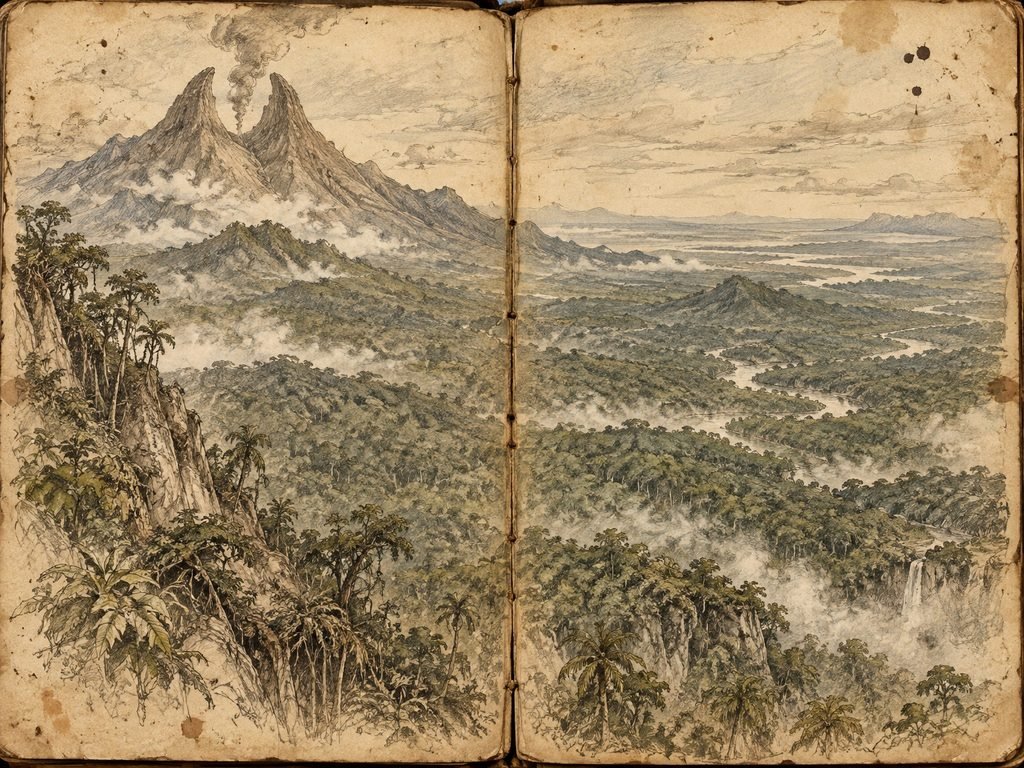
According to the Silash, the River of the People has its source in a great fire mountain known as the Ashen Tusks. The name comes from the two great peaks that curve over the source, like the tusks of some enormous beast. The Silash realms are closed to human visitors, and their accounts of the lands beyond the forests are fragmentary. Nevertheless, the possibility of locating this mountain has long fascinated Threshian explorers.
On the far side of the Dakemoon Morad runs the Ritoran Way, a difficult trade route that bypasses the great Dair Amon desert. From parts of this route, travellers can see a twin-peaked volcano among the distant mountains. It is known as Gul Elvre. Could this be the Ashen Tusks? If the two mountains are one and the same, it might provide an opportunity to solve one of the world's greatest cartographic mysteries: finding the source of the Elvari. More than that, it could reveal a route through the Dakemoon Morad and into the secret interior of the Silash Kingdoms.
The Elvari is no insignificant river. It runs through Threshia, forming the natural divide between the Expanse and the Pheadran Plain, before reaching the Sea of Whispers through a great estuary at Tarl. Further east, it emerges from the Silash forests, where it divides the great realms of Tethe Cairndel, the Endless Home, and Teleth Ethali, the Great Hunting Realm.
The annual monsoons bring immense volumes of water down from the rainforest. The resulting floods turn the Elvari into an unstoppable torrent, making even the mighty Sanshinzu, recognised as the longest river in the world, seem modest by comparison. Yet it is not simply the scale of the river that has attracted attention. What it carries downstream has raised more than the occasional eyebrow.
The debris of Silash communities, swept away by the floods, is among the more ordinary finds. Gold is another matter. Not merely grains or nuggets, but jewellery and ornaments in such quantities that it seems the metal must be commonplace among the Silash, and perhaps not especially valued. Then there are the stranger discoveries. The Silash speak of a place called the Vale of Husks, where so many tombs of the Old Ones stand that even they are wary of the place. It must lie somewhere upriver, for the monsoons occasionally wash down objects and remains that should never have been found. Some of these things, disturbingly, are still alive — and have to be destroyed.
For Threshians, denied access to the Silash realms and increasingly curious about what lay beyond them, the river presented an irresistible challenge. If the Silash would not permit them to enter their lands, perhaps the Elvari itself could provide a way in.
The Threshian Expeditions
Anyone familiar with the annals of Threshian and Silash history will know that an undertaking involving the two peoples is unlikely to end well. They hate one another with a passion that might almost be described as psychotic. There is little need to revisit that history here. The Frontier Wars and the events of the Glimmer Vale provide ample illustration.
The expeditions described below were not simply geographical surveys. They were undertaken against a background of centuries of hostility, and often became military encounters in their own right.
Adamendon's Expedition
The first major expedition was conducted by the King of Armandy, Adamendon, as part of a military campaign during the Third Frontier War. Adamendon had been a soldier in his youth and had survived a particularly disastrous expedition into Silash territory. Rather than putting him off further adventures, the experience had whetted his appetite. As King, he would eventually lead the largest incursion in Armandy's history.
The campaign struck upriver along the northern shore of Tethe Cairndel. The force encountered significant resistance, but Adamendon's own column managed to break through the Silash front line just as the wider military position began to collapse. Trapped behind enemy lines, with insufficient numbers and no clear route home, Adamendon made the decision to continue upriver, deeper into the forests.
What followed became the stuff of legend. The expedition encountered troves of golden treasures, apparently discarded in holes in the ground beneath Witchwood Groves. They also found ancient stone structures, clearly the remains of a civilisation whose builders possessed a level of technology the Silash themselves did not appear to have.
Eventually, Silash defenders caught up with the column. With no prospect of escape, Adamendon's remaining soldiers made a last stand on the banks of the Elvari. A handful were forced into the river and managed to float downstream using driftwood. Only three survivors made it home. Adamendon was last seen fighting on the riverbank.
The expedition had failed as a military operation, and its leader was lost. But the stories of the gold spread rapidly. The prospect of untold wealth in the Silash forests was enough to inspire a succession of smaller incursions and private ventures. For a time, the Elvari became less a geographical mystery than an invitation to plunder.
The College of Zun Expedition
Several centuries passed before another serious attempt was made to chart the river. This time the initiative came from the Pesh Cabal's College of Zun, which devised a surprisingly non-magical plan: sail upriver, chart the river as they went, and conduct any necessary exploration from the relative safety of boats.
The plan was based on what was then generally believed about the Silash. It was assumed that they did not navigate the river, swim or use boats. The expedition, led by the magus Carravagus, would discover how mistaken that assumption was.
Timing proved to be the first major problem. The expedition set out after the monsoons and was quickly overwhelmed by insects. Most of the magi could protect themselves with magic, but the soldiers, porters and crew were far more vulnerable. Disease spread through the party, resulting in significant loss of life.
Despite these difficulties, Carravagus managed to take the expedition as far as Maddlyn Falls. There, however, progress came to a halt. Silash forces resisted every attempt to land, preventing the explorers from climbing beyond the falls. The expedition was also repeatedly attacked from the air by Silash riders mounted on Nakani.
Unable to advance and suffering mounting losses, Carravagus eventually ordered a withdrawal downriver. He returned to tell the tale, an unusual outcome in the history of these ventures. His expedition had failed to reach the interior, but it had established that the falls were a formidable obstacle and that the Silash were prepared to defend them.
The Lethiticus Expedition
The lessons of Adamendon and Carravagus informed the next great undertaking, some twenty years later. This was a private venture, financed by a retired Zianese general and led by his son, Lethiticus.
The plan combined military strength with a more practical approach to exploration. A large force of mercenaries would be sent upriver to establish a bridgehead at Maddlyn Falls, while smaller expeditionary boats would be lifted beyond the falls to continue the journey.
It was by far the largest single enterprise in the search for the Elvari's source. Above the falls, however, the river proved to be a very different proposition. It was narrower, making it difficult for boats to avoid missiles launched from the banks. Rope bridges crossed the river through the canopy, creating further hazards and giving the Silash additional opportunities to attack.
Most importantly, the expedition discovered that the earlier assumption about Silash river use was wrong. There was an entire region where the local Silash tribe used canoes and swam. The river was not an empty corridor through which an expedition could travel unchallenged. It was part of the lives and territory of the people who lived there.
The combination of attacks from the banks, hazards along the river and growing Silash resistance proved too much. As the boat parties returned, the troops holding the bridgehead at the falls found themselves facing an increasingly dangerous situation. Local warriors were gathering in growing numbers, and it was clear that the position could not be held indefinitely.
A hasty retreat followed. Much of the expedition's equipment was abandoned upriver, and the losses were severe. Like Adamendon and many other leaders of smaller ventures, Lethiticus did not survive.
The expedition established an important limit to the western approach. A large, heavily armed force could not simply force its way beyond the falls. The Silash controlled the upper river, knew the terrain, and could bring their full strength to bear against intruders. Any future attempt would need to find another way in.
Theodis Jeaser and the Elash Riders
The last great Threshian adventure to the Elvari's source took place in the twentieth century Z, and was perhaps the strangest of them all.
Theodis Jeaser was a Tarlese merchant who had been breeding captive Elash as scouts for the Tothite Church. He recognised that flying over the forests might offer a way around the obstacles that had defeated previous expeditions. Rather than fighting their way upriver, his explorers would map the river from the air.
Few Threshians had much experience of flying. When they did, it was usually on Nakani, which could never have managed the long distances required for this undertaking. The Elash, by contrast, were drakes capable of sustained long-distance flight, although they could carry little weight. Jeaser therefore spent years developing what would become Threshia's first — and last — squadron of Elash riders.
The riders were carefully selected for their small stature, and the equipment was kept to a minimum. Jeaser himself, however, was neither small nor particularly light. This would prove to be a significant oversight.
The expedition set out with ambitious plans, but soon discovered that the Silash also rode Elash, and were considerably more skilled. Threshian riders repeatedly encountered their Silash counterparts, who picked them off one by one. Jeaser himself proved too heavy for his mount and crashed into the forest, never to be seen again.
The distances also presented a serious challenge. Even the Elash could not cover the entire route without resting, and every landing created opportunities for further encounters with Silash forces. The expedition suffered heavy losses, but its achievements were nevertheless remarkable.
The survivors travelled further into the rainforest than any human explorers before them. They mapped the location of the legendary Vale of Husks, a discovery that substantially extended Threshian geographical knowledge of the Silash interior.
Of the more than thirty riders who set out, only four returned. In Tarl, they were celebrated as heroes, their names immortalised in the city's halls of heroes. The expedition had failed to reach the source, but it had achieved something none of its predecessors had managed: a glimpse of the geography that lay deep within the Silash realms.
The Eastern Approach: Gul Elvre
While Threshian explorers were struggling to penetrate the rainforest from the west, others were attempting to reach the interior from the opposite direction. Beyond the Dakemoon Morad, the Ritoran Way offered a difficult but established route through the mountains, and the possibility of approaching Gul Elvre from the east.
If Gul Elvre was indeed the Ashen Tusks, this might provide a way to reach the source of the Elvari without having to fight through the Silash frontier. It was a tempting prospect, and one that would attract several determined adventurers.
Tomo Sakimoto and the Kellish Expedition
Tomo Sakimoto was a Kiang adventurer and the son of the lords of Jitomara. His family wealth gave him access to considerable resources, and he made three attempts to reach the elusive volcano from the Ritoran Way.
Although none of these expeditions achieved its principal objective, Sakimoto returned from his first two journeys with discoveries that made his name. Among them was an ancient ruined city which he claimed was Saddan, the mythical city of ancient Ritoria that the Pheadrans maintained they had discovered and traded with.
The expeditions became known collectively as the Kellish Expedition. Sakimoto's third attempt ended very differently. He and his entire party disappeared in the mountains during the sixteenth century Z. No reliable account of their fate ever emerged.
His journals, however, survived. They would later provide the foundation for another attempt to explore the region.
Sir Jose Haldane
In 1192 by the Trunian calendar (the twenty-second century Z), Sir Jose Haldane, a member of the Royal Society of Cartographers, revived the search. His objective was not Gul Elvre, but Saddan. Using Sakimoto's journals as his guide, Haldane followed the route into the mountains and eventually found himself on the slopes of the elusive volcano.
From there, he made a series of sketches of the distant rainforests stretching away towards the horizon. Although he failed to find Saddan, the drawings proved enormously popular. Published in the Illustrated Dalinese Times, they generated considerable excitement and brought renewed attention to the possibility of reaching the Elvari's source from the east.
Haldane had not set out to investigate the Ashen Tusks, and there is no indication that he understood the significance of what he had seen. Nevertheless, his sketches offered the first tantalising visual evidence of the vast rainforest lying beyond the mountains.
Lord Joseth Ardek
The Royal Society returned to the region in 1201 by the Trunian calendar (2282 Z). This time the expedition was led by Lord Joseth Ardek and guided by Gullaine, an Iliesh scout who had accompanied Haldane on his original journey.
The party returned to Haldane's location and began exploring the valleys beyond it, searching for a route down into the rainforest. The terrain proved difficult, and the mountain itself soon presented a more immediate danger. Volcanic activity increased, forcing the expedition to withdraw.
They left just in time. In 1202, Gul Elvre erupted in a massive explosion, sending ash as far east as Daren Kair. Once again, the search for the source of the Elvari had been brought to an abrupt and disastrous halt.
Ardek did, however, return with something of considerable interest: a photograph showing a faint line running through the rainforest canopy. It might have been the Elvari itself. If so, it offered the first possible indication that the river could be identified from the eastern slopes of the Dakemoon Morad.
The expedition had not reached the river, let alone its source, and the identity of Gul Elvre remained unresolved. But the possibility that it was the Ashen Tusks had gained new credibility.
The Search Resumes
Events in Trunia soon overtook the Royal Society's resources and ambitions. The civil war brought an end to serious expeditions, and for nearly a century the search for the Elvari's source remained little more than an academic interest.
Now, however, the civil war is over, the country is stable, and interest in exploration is growing once again. The journals of Sakimoto, the sketches of Haldane and the findings of Ardek have renewed relevance. The question remains as compelling as ever: is Gul Elvre the Ashen Tusks, and could the river be reached from the east?
The next expeditions would not simply be repeating the failures of those who came before. They would be tracing Sakimoto's last known route, returning to the slopes of Gul Elvre and attempting to find a way down into the rainforest. For the first time, the search for the source of the Elvari may have a realistic chance of success.