The Madras — A Fortress of Faith and War
 Widder Press
The Madras — A Fortress of Faith and War
Blog : Storybuilding
07/11/2026
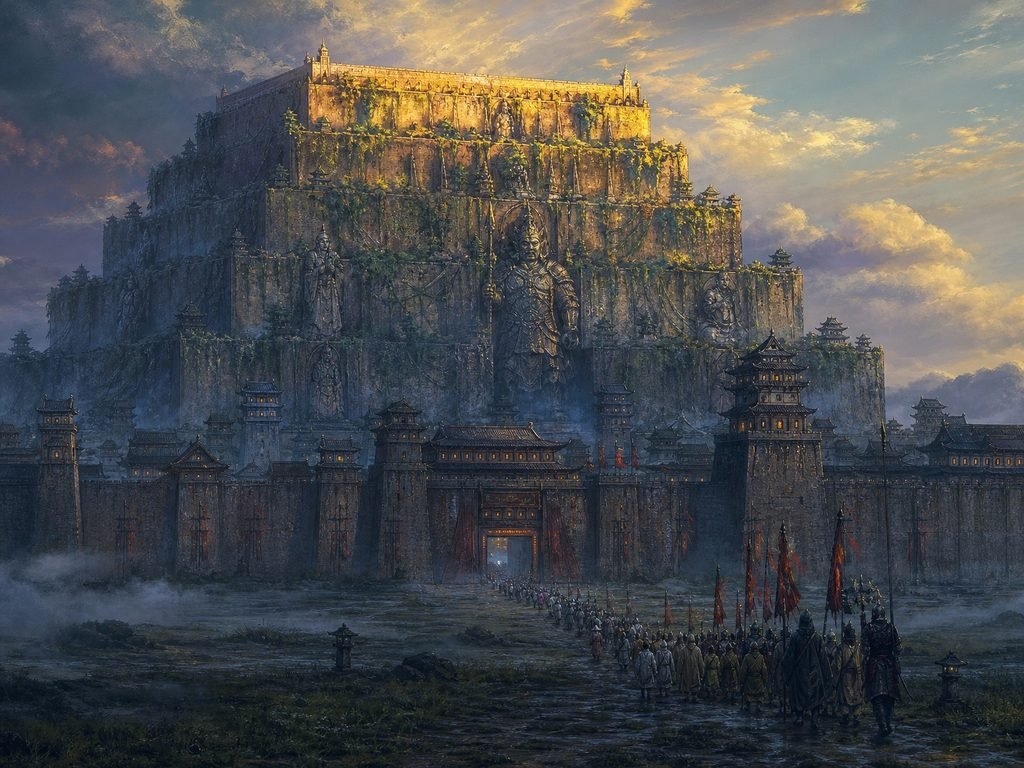
There are few buildings in Thayathorn that command the presence of the Madras. Rising above the city of Nakamura, this colossal monastery is both a place of worship and a centre of religious and political influence. Its stepped walls form the shape of a vast rectangular pyramid, rising through nine floors to a broad, flat summit. From a distance, its shallow terraces give the impression of sheer, unbroken walls, while trees and vines wind their way down the stonework, entwined with statues of Arianna, the Prophets, and the Dwali who have led the monastery through the generations.
The Madras is home to more than two thousand Lightwardens, with at least as many priests, pilgrims and attendants living within its walls. It is, in effect, a city within a city: a vast religious community dedicated to the worship of Arianna, Kell’s goddess of war.
But the Madras is more than a monastery. In the unsettled years following the collapse of Imperial authority, it has become one of the most influential religious institutions in the north, and its ambitions have brought it into open conflict with one of Threshia’s most powerful faiths.
The Dwali
The Madras is led by the Dwali, the nineteenth in an unbroken succession of abbots. The position is unusual: traditionally, each Dwali is born, lives and dies within the walls of the Madras, never leaving the monastery. A successor is chosen at birth following the death of the previous Dwali.
Within the hierarchy of the Arianne faith, the Dwali holds no formal authority beyond his position as Abbot. The spiritual leadership of the Sodality of the Lightwarden in Kell belongs to Aessius of the Bright Isle in Amasaki, who follows the guidance of the Prophet in Sava, Sharathan.
Yet the distinction between formal authority and influence has become increasingly important. Aessius is widely regarded as a cautious traditionalist, content to preserve established doctrine. The Dwali, by contrast, is charismatic, eloquent and unafraid of controversy. His sermons have made him a figure of extraordinary popularity, and many of the faithful now regard him as Arianna’s true representative in the mortal world.
His appeal rests partly on a challenge to the established teachings of the Prophet. Where the Prophet teaches that Arianna’s divine light descends through kings and hierarchies, sanctifying the rule of the ordained and the obedient, the Dwali preaches that Arianna withdrew her light from the thrones of men and bestowed it upon those who fight and suffer in her name.
In his sermons, kings and priests are described as the shadows of a dying flame, while soldiers, labourers and martyrs are the bearers of her living fire.
The message has found a receptive audience among the poor and dispossessed, particularly soldiers and mercenaries who find dignity in the idea that faith is proved through endurance and struggle, rather than privilege or birthright.
Embassies of the Light
The Dwali's influence now extends far beyond Nakamura. The Madras has established a network of Embassies across the four Quad Cities of Threshia, openly recruiting followers and offering what it calls divine partnerships to political and mercantile leaders.
These Embassies are controversial. To their supporters, they are a means of spreading Arianna’s faith and establishing closer ties between the Madras and the communities of Threshia. To its opponents, they are an attempt to extend Kellish religious influence into foreign territory.
The Tothite Church regards Arianna and the other Latter Day Gods as heretical. The Madras's growing presence in Threshia is therefore seen not simply as religious competition, but as a direct challenge to the authority of the established faith.
The Dwali has shown little inclination to retreat. His popularity continues to grow, and the Madras has used the uncertainty following the fall of the Empire to extend its reach across the continent.
The War on the Pheadran Plain
The conflict has become most acute between the Madras and the Shurza Tothite Preceptory in Pathay. As the closest of the Tothite Preceptories to Nakamura, Shurza has taken the lead in opposing the Lightwardens and has declared open war on the monastery.
Nakamura itself is a formidable obstacle. The city is protected by the enormous Hing Walls, designed by the Pesh Cabal architect Katsumori Hing. Standing approximately 230 feet high and crowned by nineteen towers, the walls command the surrounding approaches. Their three great gates can each be sealed from within, making a direct assault exceptionally difficult.
The fighting has consequently centred on the Pheadran Plain, where skirmishes between the two faiths have become increasingly common.
The other Tothite Preceptories have so far refused to join the conflict, observing the established rules of engagement intended to prevent an escalation into a full Holy War. Should those rules be broken, however, all four Preceptories would be expected to mobilise their forces together.
For now, the conflict remains contained, but the possibility of a wider religious war hangs over the region.
A City Under the Shadow of the Madras
The Madras has also changed the character of Nakamura itself. Once a bastion of the Emerald Host guarding the frontier between Kell and Threshia, the city became a symbol of Imperial tragedy when its garrison refused to surrender following Shiatzu’s capitulation. Three hundred and six Imperial officers chose suicide rather than submit to foreign rule, and many of their soldiers followed them.
The subsequent decision to place Nakamura under the control of the Madras has had consequences far beyond the city's religious life. What was once a military stronghold has become an increasingly important centre of religious administration and influence.
Today, Nakamura has a population of around ninety thousand, drawn from a surprisingly diverse mix of Shiatzu, Kellai, Threshians and non-human communities. The Madras and its pilgrims form a substantial part of that population, while its influence reaches into the wider political and commercial life of the region.
The monastery's presence is impossible to ignore. Its Lightwardens, its growing network of Embassies and the sermons of the Dwali have made it a power in its own right, regardless of the limits of his formal religious office.
A Wonder of the Faithful
The Madras is one of the great religious monuments of Kell, but its significance cannot be measured by its size or architecture alone. It represents a faith that has grown beyond the boundaries of its traditional authority, and a religious leader whose influence increasingly challenges those who would claim to speak for Arianna.
Across the Pheadran Plain, the Tothites watch the Madras with suspicion. In Amasaki and Sava, the established leadership of the Arianne faith must contend with the popularity of a Dwali who has become something more than an abbot.
And within Nakamura, thousands of Lightwardens remain devoted to the man who leads them.
The Madras may have been built as a place of worship, but in the present age it is also a fortress of religious and political power. Whether that power will bring the faithful together or draw the region into a wider war remains to be seen.
For Your Table
The Madras offers a wealth of possibilities for a Game Master. It is a religious institution, a political power and a military stronghold, with enemies on its doorstep and competing loyalties within its own faith.
A few possible adventures:
- The Dwali's Embassy: A delegation from the Madras arrives in one of the Quad Cities to negotiate a divine partnership with a powerful merchant or political family. The characters are drawn into the negotiations, where religious conviction, political ambition and commercial interests may not be quite what they seem.
- Across the Pheadran Plain: Skirmishes between the Lightwardens and the Shurza Tothite Preceptory are becoming increasingly dangerous. The characters might be hired to escort a delegation, investigate an incident or prevent a local clash from escalating into a wider conflict.
- A Question of Authority: The Dwali's influence is growing, but his formal authority remains limited. A dispute over doctrine or leadership could place the characters between the Dwali, Aessius of the Bright Isle and the Prophet in Sava. Who truly speaks for Arianna?
- The Rules of Engagement: The uneasy peace between the Tothite Preceptories is maintained by established rules governing the conflict. Someone appears determined to break them. The characters must discover who is responsible before all four Preceptories mobilise.
- The Nineteenth Dwali: The Dwali has never left the Madras, and his position is traditionally determined at birth. What happens when questions arise about his succession, his authority or the circumstances surrounding his predecessor's death?
The Madras need not be the destination of an adventure. Its influence reaches across borders, into courts and trading houses, and onto the battlefield. Characters might encounter its agents far from Nakamura, find themselves caught between rival faiths, or discover that a seemingly ordinary political dispute has become a contest over the future of the Arianne faith.
The Madras is a place where faith and power are inseparable. For a Game Master, that makes it a particularly fertile ground for adventures.