
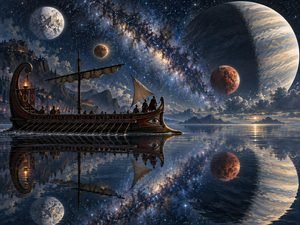
On the Physical Heavens and the Reckoning of Time
We inhabit the third of five worlds that circle our sun. This is not mythology. This is observation, confirmed across centuries of Cabal records and corroborated by the astronomical traditions of every serious scholarly institution on Thayathorn. Our world is called Edran. The others, in order from the sun outward, are Agriel, Masul, Deshal, and Gleyre.
Of these, Masul and Gleyre are visible to the naked eye on clear nights — Masul burning silver-white and steady, Gleyre a cooler, bluer light that appears and disappears with the seasons. Agriel, being closer to the sun than we are, is rarely seen; it appears only briefly at dawn or dusk, too close to the sun's glare to observe comfortably. Deshal is faint, requiring patience and a clear horizon, best observed in the deep months of its namesake season.
I raise this not merely as astronomical background but because the planets are not incidental to the structure of Edran's magic. They are its architecture. The astral tides — which we will examine exhaustively in Part Two — are planetary in origin. Their deep rhythms, their seasonal surges, the broad magical climate of any given month: all of this flows from the relative positions and gravitational influence of these five worlds. The Pheadran scholars understood this, in their way, and it is no accident that their calendar bears planetary names. They were building something on the right foundation, even if the structure they raised upon it was, as we shall see, somewhat imprecise.