
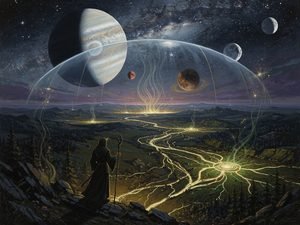
On the Astral Heavens, the Nature of Ley and Mana, and the Consequences of the CovenantOn the Physical Heavens and the Reckoning of TimeNew!!
Begin with what we know. Or rather — begin with what we believe we know, which is a different thing, and the difference matters.
The world we inhabit — the temporal world of Thayathorn, of stone and weather and the turning of seasons — is not the totality of what exists. Every serious magical tradition on this continent, from the Pesh Cabal to the Royal Society to the oldest Amonite practitioners, agrees on this much. Beyond the material world lies something else. The nature of that something else is where agreement ends.
The Cabal's current model — and I stress that it is a model, not a map — proposes the following structure. Picture it as a series of concentric layers, though I warn you immediately that this spatial metaphor is imprecise. The planes do not sit neatly inside each other like the layers of an onion. They overlap. They bleed into each other at their boundaries. The metaphor is useful for instruction and should be abandoned the moment it becomes a constraint on thinking.
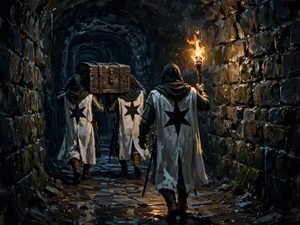
The Kingdom that was quietly forgotten
There are histories that end with a battle, a treaty, or the death of a ruler. Dauria’s history is less obliging. Its Kingdom disappeared from the maps, its authority was reduced to a memory in the merchant cities, and the Confederation that followed preferred to speak of liberty rather than inheritance. Yet a royal house remained, and the old name did not vanish as neatly as later histories would have us believe.
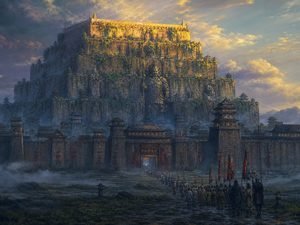
The Madras — A Fortress of Faith and War
There are few buildings in Thayathorn that command the presence of the Madras. Rising above the city of Nakamura, this colossal monastery is both a place of worship and a centre of religious and political influence. Its stepped walls form the shape of a vast rectangular pyramid, rising through nine floors to a broad, flat summit. From a distance, its shallow terraces give the impression of sheer, unbroken walls, while trees and vines wind their way down the stonework, entwined with statues of Arianna, the Prophets, and the Dwali who have led the monastery through the generations.
The Madras is home to more than two thousand Lightwardens, with at least as many priests, pilgrims and attendants living within its walls. It is, in effect, a city within a city: a vast religious community dedicated to the worship of Arianna, Kell’s goddess of war.
But the Madras is more than a monastery. In the unsettled years following the collapse of Imperial authority, it has become one of the most influential religious institutions in the north, and its ambitions have brought it into open conflict with one of Threshia’s most powerful faiths.